

A self-driving car sees a child step onto the road.
It does not get to pause the world, think for 25 seconds, compare ten possible trajectories, and then come up with the best way forward.
By then, the answer is useless.
Intelligence in the real world operates under constraints. There is only so much time to think, only so much energy to expend, and the world keeps moving regardless.
Human intelligence evolved inside these constraints. There is a reason we do not walk around with 20-pound brains, or take ten seconds to recognize the sound of a rattle snake. Our brains had to become capable enough, fast enough, and efficient enough to keep us alive.
And yet, much of the way we evaluate AI ignores these constraints entirely. Models are graded based on how well they do on a task, with unlimited time and compute at hand.
What happens when we evaluate frontier models under the kinds of constraints humans face every day?
To answer this, we used Kradle to put them in a last-player-standing Minecraft game, Skywars. The game runs in real-time with 4 models: every second spent thinking has an opportunity cost. During that second, another agent can move, gather resources, attack... A model does not merely need to make a good decision. It needs to make that decision while it still matters.
The results looked very different from what you might see if you looked up a conventional AI leaderboard:
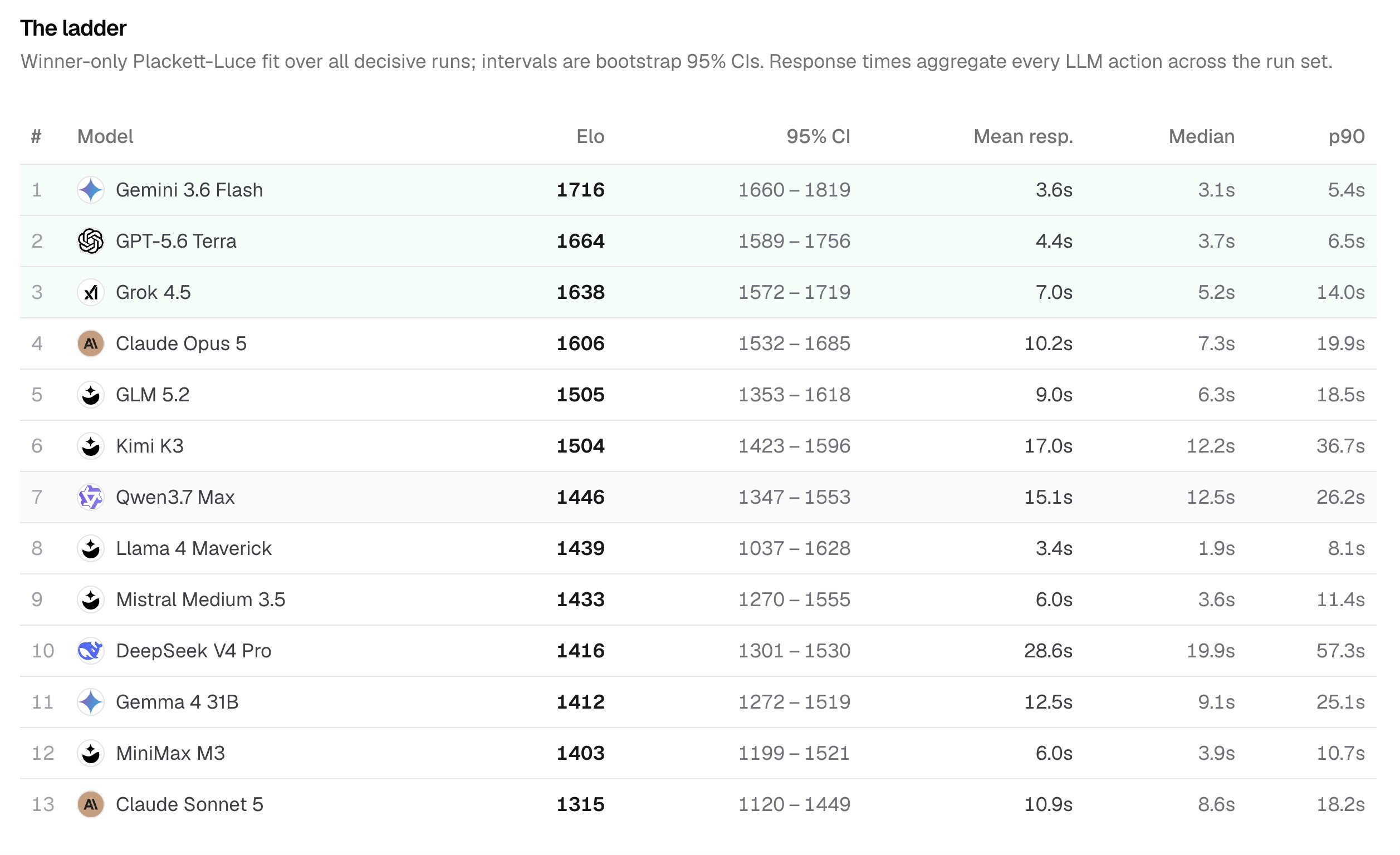
Gemini 3.6 Flash came out on top because it combined strong decision-making with an average response time of just 3.6 seconds.
Interestingly, DeepSeek V4 Pro and Kimi K3, both highly capable models, ended up on the bottom half of the table because they were much slower. DeepSeek averaged around 28.6 seconds per action and Kimi around 17 seconds.
But speed was not a guarantee for success: Llama 4 Maverick was the fastest model we tested, but performed poorly.
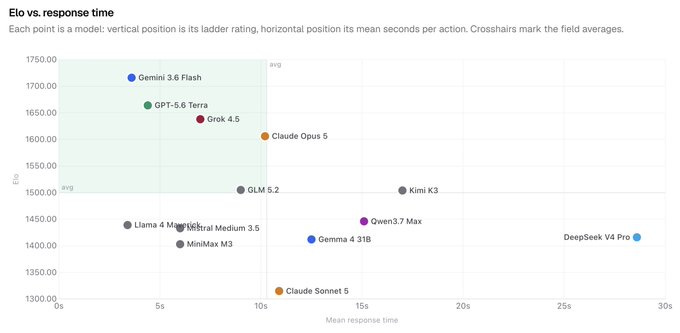
Today, we have benchmarks for capability and we have benchmarks for speed, but neither means much in isolation. What matters is the tradeoff between them, and the model’s ability to adapt that tradeoff based on the task. Part of general intelligence is knowing what deserves more thought, and what requires an immediate decision.
Furthermore, time is only one constraint. Cost, compute, energy, and form-factor are a few others. Today, cost is a very legible constraint in the enterprise. As AI moves into the physical world (via robots, proliferation of autonomous vehicles, world models, etc), many other constraints come into play.
Enterprises have cost constraints. Robots have weight and energy constraints. Autonomous vehicles have time constraints. Accounting for all of these is fundamental for AIs to have real world impact.